Who Actually Prints Your Merch: A Blueprint for Vetting Suppliers
Most merch suppliers do not make what they sell. A blueprint for telling in-house merch production from a broker, and why it changes what goes wrong.
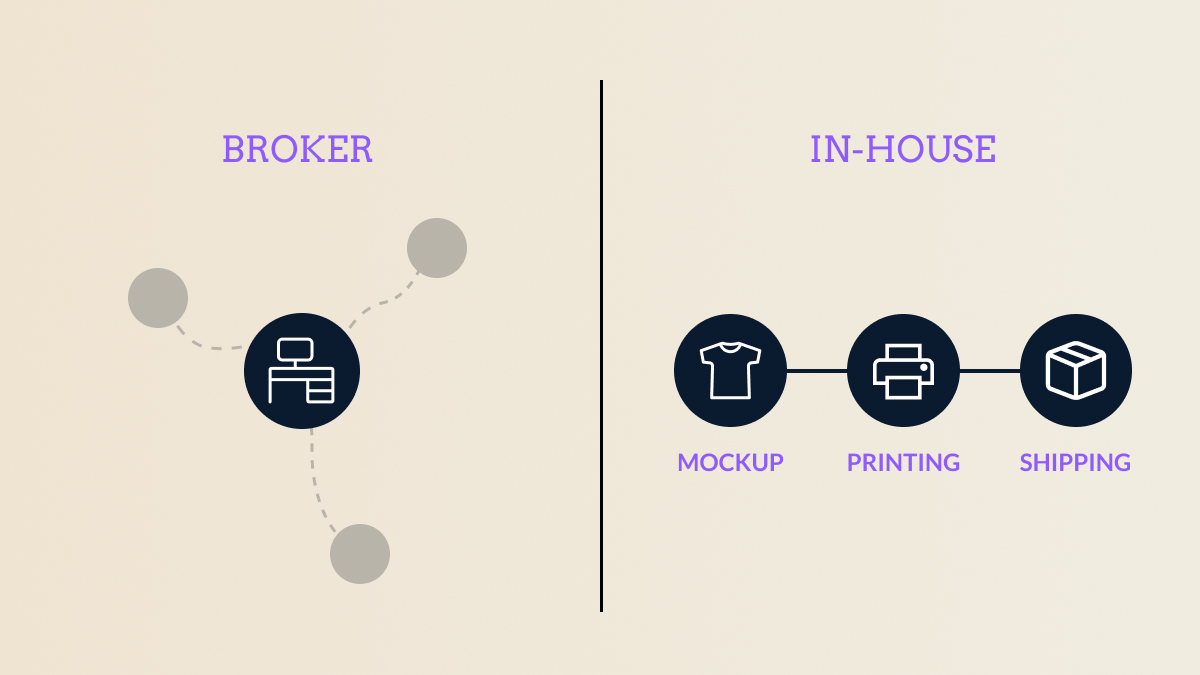
You have a supplier. They have a good catalog, a responsive account manager, and one email address you send everything to. You place an order, the mockup looks right, and a couple of weeks later the boxes arrive. From where you sit, it is a clean operation with one point of contact.
Then a batch comes back a shade off, or a run is late, and you learn how the arrangement actually works. You call your contact, and your contact cannot fix it in the room. They have to call someone else, because your supplier didn't print the items. They ordered them from whoever does. This is a blueprint for finding that out before the order, not after the bad batch, because it decides what your one point of contact can actually do for you.
The short version: most merch suppliers hold a catalog and subcontract the actual printing, so you have one contact but no line of sight to the machine. In-house merch production puts the mockup, the printing, the quality check, and the fix under one roof. A few direct questions tell you which one you are dealing with.
Why it matters who actually prints your merch
The common assumption is that a merch supplier is a small factory. Most are not. They hold a catalog, take your order, and subcontract the printing, embroidery, and decoration to production shops you never see. There is nothing shady about it; it is how a large part of the market is built. But it has three consequences that only surface under pressure.
The timeline you were quoted isn't really your supplier's timeline. It is their subcontractor's queue, which your supplier doesn't fully control or see. "About two weeks" is an estimate of someone else's schedule.
A bad batch turns your account manager into a messenger. The proofs weren't done where the printing happened, so a colour that drifted has to go back down a chain, get diagnosed by people you can't talk to, and rerun on a queue that was already full. A problem that should cost a conversation costs a week.
Quality is whatever the subcontractor did that day, checked by whoever your supplier trusts. Sometimes that is excellent. But you are trusting a handoff you can't observe, on the one product that carries your logo out into the world.
The blueprint: how to vet a merch supplier's production
You can tell in-house merch production from a brokered catalog with five questions. Ask them before you place the order.
- Do you print and decorate in-house, or subcontract it? The direct question. A maker answers plainly and can tell you which methods they run themselves. A broker gets vague or points to "trusted production partners."
- Who controls the timeline you just quoted me? If the date depends on a third party's queue, the honest answer makes that clear. You want the person quoting the date to control the schedule it rests on.
- What happens to a bad batch, and how fast? A maker fixes it in the building. A broker has to send it back down the chain. Listen for whether the fix is a conversation or a forwarded email.
- Do you photo-proof before dispatch, from the production floor? In-house quality control means the check happens where the item was made, not bolted onto a delivery. Ask to see that step.
- Do you hold stock and restock in-house? This one only matters for anything ongoing. If your merch is stored and shipped on demand, a maker restocks on their own schedule; a broker reopens a subcontractor negotiation each time.
If the answers are plain and specific, you've found a producer. If they're smooth but evasive, you've found a catalog with a phone number.
What in-house production changes
When printing and decoration sit under one roof, your point of contact gets real authority. You get a real answer on timing, because the person quoting the date controls the schedule. You get a real fix on a bad batch, because the proof, the print, and the correction are in the same place. And you get quality control done by the people who made the item, with a photo proof before it ships. The single point of contact is still there; the difference is that behind it is a production floor, not a purchase order to someone else's.
Where SoMerch fits
SoMerch prints and produces in-house. The facility behind it, Prisma Ltd., has run production for years, and SoMerch is the platform built on top of it, not a catalog reselling someone else's output. It covers a real range of methods, so the item drives the decoration: full-colour digital transfer, UV, edge-to-edge sublimation, silkscreen, pad print, and laser engraving. Every order runs through tiered quality checks with photo proofs before dispatch, mockups come back the same day, standard production runs around eight business days, and there is a 48-hour express line for selected items. Because the same operation makes the goods, stores them, and ships them across Europe, accountability doesn't fracture when an order becomes a program.
The five questions, in one place
Save these for your next supplier call:
- Do you print and decorate in-house, or subcontract it?
- Who controls the timeline you quoted?
- What happens to a bad batch, and how fast can you fix it?
- Do you photo-proof from the production floor before dispatch?
- Do you hold stock and restock in-house?
The catalog and the account manager are easy to compare between suppliers. The question that decides what actually happens when a batch goes wrong is whether the company you're paying makes what it sells.