Multi-Entity Merch Orders: A Blueprint for Getting Invoicing Right
A blueprint for multi-entity merch orders: the fix is per-entity invoicing tied to the delivery country, not shipping. Here is how to structure it.
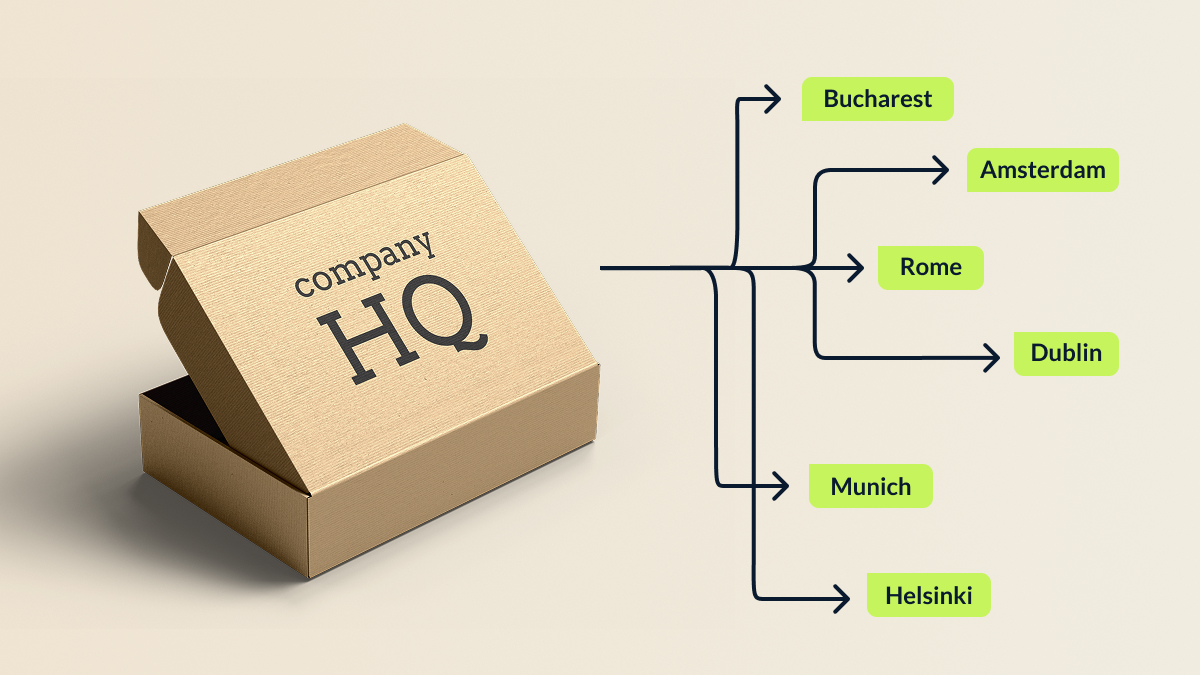
If you run procurement or finance for a group with subsidiaries in several countries, you have signed off a merch order that touched more than one entity. New-hire kits for offices in five markets. A run of logo apparel for a company-wide kickoff. Gifts going to people spread across the map. On paper it is one decision and one budget line. The trouble is that the decision and the money don't belong to the same entity, and that gap is where a multi-entity merch order quietly turns into weeks of finance cleanup.
The merchandise is almost never the hard part. The hard part is a question nobody asks until the invoice lands: which legal entity is being billed, and does that match where the goods went. This is a blueprint for structuring the order so the answer is right the first time.
The short version: the fix is per-entity invoicing tied to the delivery country. Brief the order once at group level, then have the supplier invoice each receiving entity separately, under its own VAT number, for the country the goods land in. Inside the EU there is no customs and no import VAT at internal borders, so the whole problem is billing, not shipping.
Why multi-entity merch orders go wrong on invoicing, not shipping
Most groups default to one of two setups, and both move the burden around rather than removing it.
The first is that headquarters pays for everything. One entity, say the Dutch holding company, funds the whole order. The goods go out, everything arrives, and now the Dutch entity is sitting on a cost that belongs to subsidiaries in Germany, Spain, Poland, and elsewhere. So finance has to re-invoice each subsidiary internally to push the cost onto the right books. That is intercompany billing, transfer-pricing documentation, and a reconciliation across every entity, for what was supposed to be a box of logo hoodies.
The second is the opposite reflex: take the goods ex-works and self-organise, to dodge the re-invoicing mess. Now whoever owns the order isn't running a merch project, they are running a freight desk, with a separate shipment and a separate set of paperwork per destination.
It is worth being precise, because this is where a lot of advice gets it wrong. When goods move between EU member states, they move as intra-community supplies: no customs clearance at internal borders and no import VAT paid to cross them; each receiving entity simply accounts for VAT locally under its own number. So the intra-EU problem is not customs and not who pays VAT at the border. It is narrower and more stubborn: which legal entity gets the invoice, and does it match the delivery country.
The blueprint: how to structure a multi-entity merch order
Five steps put the cost where the goods went, with no cleanup afterwards.
- Brief the whole order once, at group level. One person consolidates everything the supplier needs: quantities, artwork, delivery addresses, and the legal entity behind each destination. That is the entire coordination job.
- Have the supplier invoice each receiving entity separately. Correct legal buyer, that entity's own VAT number, the country the goods are delivered to. One invoice per entity, not one to HQ.
- Let each entity account for its own VAT locally. Intra-EU, this is routine: no border customs, no import VAT, each subsidiary handles VAT under its own number exactly as it would for any other purchase.
- Push customs and importer-of-record duties onto the supplier for any non-EU leg. Where an order does leave the EU, the supplier should clear customs and act as importer of record, so no entity of yours becomes importer of record by default.
- Keep one point of contact for the whole order. The group-level complexity exists; it just lives on the supplier's side, tracked through one relationship, not ten.
Get step two right and steps three through five mostly take care of themselves. The cost lands correctly at the source, so there is nothing to reconcile later.
Where SoMerch fits
Per-entity invoicing across the EU is how SoMerch runs a multi-entity merch order by default. You brief the order once. SoMerch issues a separate invoice to each receiving entity, correct legal buyer, its own local VAT number, the delivery country, so your HQ never re-invoices internally and finance isn't reconciling a group purchase for the next quarter. Around that, the rest stays under one roof: the items are produced and decorated in-house with your logo, and multi-address delivery across Europe is the standard, whether that's bulk to each office or a split down to individual remote employees. Where a leg leaves the EU, SoMerch carries customs and acts as importer of record on that leg.
Questions to ask before you place it
Pressure-test any supplier on this in one call:
- Can you issue a separate commercial invoice to each of our entities, each under its own VAT number, matched to the delivery country?
- Will each subsidiary's cost land correctly without us re-invoicing internally afterwards?
- Do we brief the order once, at group level, with one point of contact for the whole thing?
- For anything shipping outside the EU, will you handle customs and act as importer of record so we don't?
The merchandise was never the complicated part of a multi-entity merch order. The invoicing was. Get that right at the source, and a group order stops being a quarterly finance cleanup and becomes one order, billed correctly, done.