Corporate Gifts for Employees: Consistency Is the Actual Benefit
Employee gifts look simple compared to client gifting. That's exactly why they drift. Here's what makes them consistent instead of ad hoc.

Intro
Corporate gifts for employees feel like the easy version of client gifting. There's no external relationship riding on them, no impression to manage in front of someone outside the company. That lower stakes feeling is exactly why they rarely become a real process - and exactly why they end up more inconsistent than the gifting programs companies actually plan carefully.
The low stakes are the trap
Client gifts get planned with care because something external is on the line. Corporate gifts for employees feel lower-risk by comparison, so they tend to get handled reactively - whoever has a spare hour that week sorts it out, orders whatever is fastest to source, and moves on.
The result is that the moments that matter most to employees themselves - starting a new job, being thanked for a hard stretch, coming back from parental leave - end up the least planned-for occasions on the calendar. Not because anyone decided they mattered less. Because nothing about them was ever set up as a repeatable process in the first place.
Where it actually breaks down
One new hire gets a proper onboarding kit because someone happened to have the time and headspace that week. The next hire, starting a month later, gets a Slack welcome message and not much else, because the person who usually handles it was out or buried in something else.
A thank-you gift after a demanding quarter gets arranged for one team but quietly skipped for another, not out of any decision - just because nobody owns the call on who gets one and when. A remote hire or someone in a different country is the person most likely to be missed entirely, because their gift requires one extra step - an address, a shipping arrangement - that nobody remembers to take when the process is being improvised from scratch each time.
Take an ordinary case: two new hires starting in the same month, in the same department. One has a kit waiting on their desk on day one, because HR happened to plan ahead that particular week. The other has nothing, because the person who usually orders these things was traveling and nobody else knew it needed doing. Both hires compare notes eventually, often within the first week, and the gap becomes a small but real data point in how each of them reads the company's culture. Only one of them got the experience the company actually intends to offer.
Why this is a program problem, not a generosity problem
Nobody sits down and decides to treat employees inconsistently. It happens by default, quietly, whenever nothing has been planned ahead of the moment it's needed. Each occasion - onboarding, a thank-you, a welcome back after leave - gets treated as its own isolated request, worked out from scratch by whoever happens to be free that day.
The actual cost here isn't the absence of a gift. It's the inconsistency. Employees talk to each other, and a visibly uneven pattern - one person got a thoughtful kit, another got nothing - reads worse than if there were no program at all. A gap everyone can see is more damaging than a gap nobody notices.
What makes it consistent
The fix isn't a bigger budget or more elaborate gifts. It's fewer moments where the response has to be improvised on the spot.
Decide once what the occasions actually are - onboarding, a thank-you round, a welcome back - and what each one looks like, so the same answer applies every time one comes up rather than being reinvented under time pressure. Have the gift ready before the trigger date arrives: the kit produced and in storage before the next hire's start date, not ordered the week they're already at their desk.
How SoMerch fits
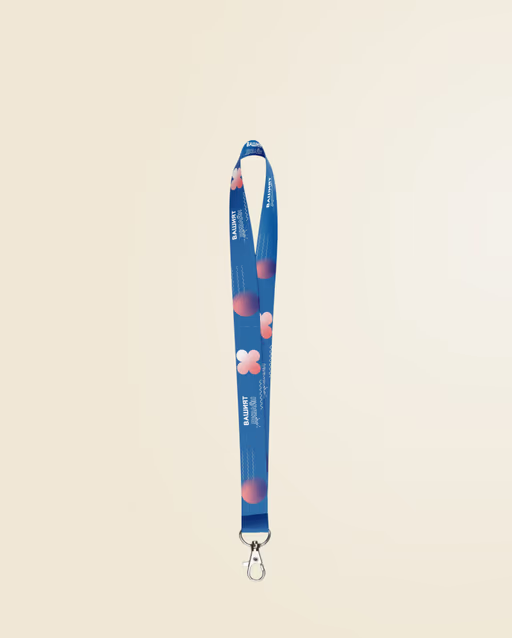
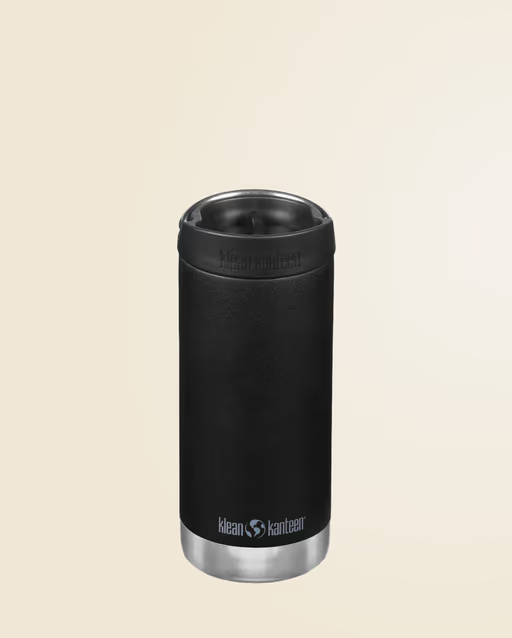
Kitting and free warehousing for up to six months mean an onboarding kit or a thank-you gift gets produced once and released the moment it's actually needed, rather than sourced fresh under pressure by whoever happens to be covering that week. Multi-address shipping across Europe means a remote hire or an employee in a different office is handled exactly the same way as anyone else - not treated as the special case that gets missed.
A single shareable view with pricing, timeline, and mockups also means the plan doesn't live only in one person's head. Whoever is covering the process that week can see what was decided and execute it, instead of having to rebuild the whole thing from memory or guesswork - which is the whole point of treating corporate gifts for employees as a program rather than a rotating favor.
This is the employee-facing version of the same gap covered in employer branding more broadly - what an employee actually experiences after they join is the real signal of what the company is like to work for, not what got promised in the hiring process. A gifting program that runs the same way every time is one small, concrete piece of keeping that promise consistent.
The specific occasions worth planning for
Three moments tend to carry the most weight, and each has its own shape worth thinking through separately: the onboarding pack a new hire receives before or on their first day, a thank-you gift recognizing a specific effort or milestone, and a welcome-back kit for someone returning after extended leave. Each one has different timing pressure and a different tone - onboarding is predictable and plannable months in advance, a thank-you is often reactive to a specific event, and a welcome-back needs to land as warm rather than routine. Treating them as three distinct, pre-planned answers rather than one generic "employee gift" bucket is what actually makes the consistency stick.
Closing
The risk with corporate gifts for employees was never that someone forgets to be generous. It's that generosity ends up looking different every single time it happens, depending entirely on who was free that week. The fix isn't spending more. It's deciding once what the standard is, instead of deciding it fresh, differently, every time an occasion comes around.