Corporate Gifts: Choosing Is the Easy Part
There's no shortage of corporate gift ideas. The hard part is turning a chosen idea into a personalized, delivered order. Here's what closes that gap.
Intro
Someone gets asked to sort out corporate gifts - for a client list, a holiday round, an event, a new batch of hires. The instinct is to search for ideas, and the internet delivers: dozens of "best corporate gifts" roundups, each with fifty items ranked by category, price, or occasion.
Ten minutes into that search, there is a longer list of options and still no gifts. The idea was never actually the hard part.
Choosing is the easy part
There is no shortage of corporate gift ideas. Mugs, notebooks, tech accessories, gift hampers, apparel - every list covers roughly the same ground, because the ground has been covered many times already. Picking three or four options that would work for a given budget and recipient takes a few minutes with any of those lists open.
What none of those lists cover is what happens after the idea is chosen. They stop at inspiration, right where the actual work begins.
Where it actually breaks down
The idea takes five minutes. The order takes two weeks of back and forth.
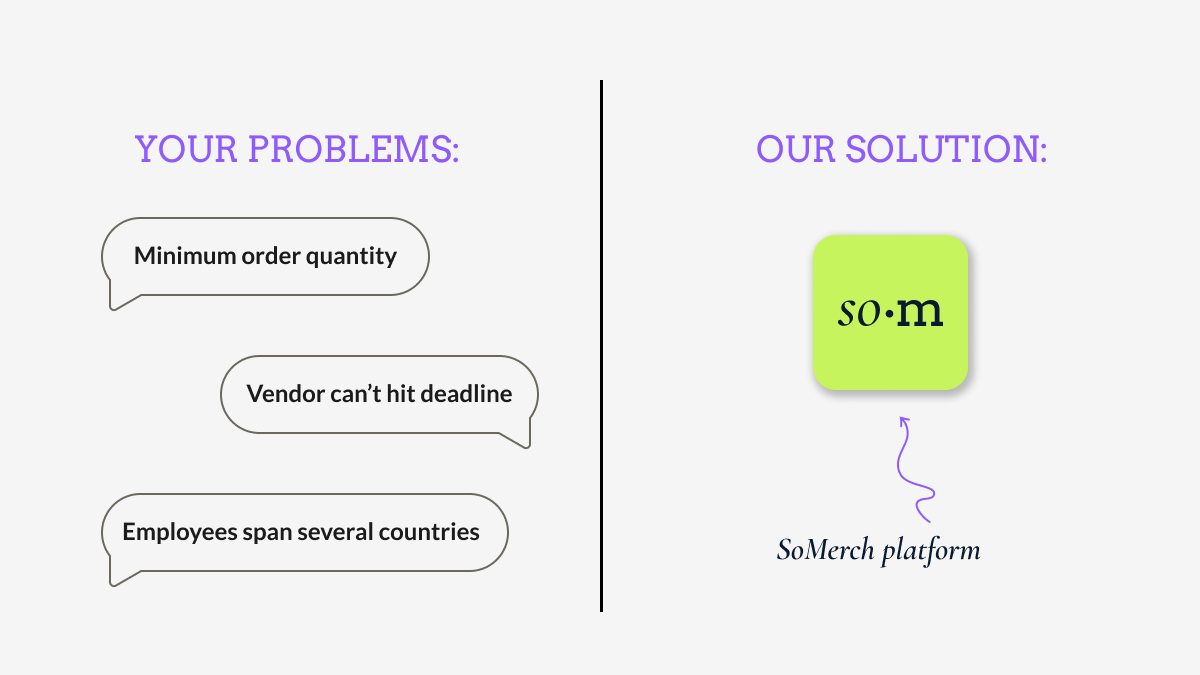
A minimum order quantity built for volume runs does not fit a fifteen-person client list. A vendor who can personalize the item well cannot hit the date it is needed by. A recipient list that spans a few countries turns a straightforward gift into its own logistics project, because shipping was never part of the vendor's actual offer - just an afterthought tacked onto production.
Take a fairly ordinary case: a forty-person client gift round for the end of the year. The gift itself gets picked in an afternoon - a good notebook, or a well-made mug, something with the company mark on it that a client will actually keep on a desk. Then the list has to go somewhere. Twelve of those forty clients are in other countries. The vendor who can personalize the item at that quantity does not handle multi-address shipping, so now there is a second vendor, or a courier arrangement built by hand, or a delay while someone works out customs paperwork for a handful of addresses. What looked like a single task on a Monday morning is still open two weeks later, and the gift itself was never the reason why.
Why this is an execution problem, not an ideas problem
The internet has already solved the ideas problem. That is what fifty-item roundups of corporate gifts are for, and they do that job reasonably well.
What is missing is a straightforward path from a chosen idea to a delivered order - one that does not involve separately briefing a product supplier, a printer, and a courier for what is often a one-off or occasional request. That coordination is where the actual time goes, and it has nothing to do with which mug or notebook got picked.
This is the same gap that shows up in brand identity more broadly. A gift with a company's mark on it is a physical touchpoint, no different from a hoodie handed to a new hire or a notebook shipped to a distributed office - and the same coordination problem that lets an identity drift between subcontracted print runs is what turns a simple gift list into a two-week project. The fix, in both cases, is fewer places for the request to be reinterpreted.
A framework for choosing, once the idea itself is settled
Once the order-execution problem is out of the way, the choice itself narrows down fast along a few lines.
By recipient - gifts for clients read differently than gifts for executives, employees, or new hires. A client gift needs to feel considered without being personal in a way that reads as presumptuous; an executive gift can sit at a higher price point; an employee or new-hire gift needs to work at volume without feeling generic.
By occasion - a holiday round has different constraints than a one-off thank-you or a recurring anniversary program. Holiday gifting usually means a fixed deadline and a large list at once. A thank-you is smaller and more time-sensitive. An anniversary program is recurring, which changes the calculation entirely - it is worth setting up once rather than solving from scratch every year.
By budget and positioning - everyday useful items sit at one end, premium or luxury pieces at another, with eco-friendly and personalized options cutting across both. None of these are mutually exclusive; a gift can be both personalized and modest in price, or premium and produced sustainably.
The specific item matters less than getting these three questions answered first. Once they are, most of the "which gift" decision resolves on its own.
Browse gift guides by category
The categories above map to dedicated guides, each covering a specific type of corporate gift in more depth - what tends to work, what to watch for, and where the budget conversations usually land. As each one publishes, it gets linked from here:
By recipient: corporate gifts for clients, corporate executive gifts.
By positioning: luxury corporate gifts, cool corporate gifts, custom corporate gifts, corporate logo gifts, eco friendly corporate gifts, personalised corporate gifts.
By type: corporate gadget gifts, innovative corporate gifts, small corporate gifts, practical corporate gifts, unusual corporate gifts.
How SoMerch fits
A single catalog spanning drinkware, apparel, tech, and stationery means a client gift, an employee gift, and an event giveaway can come from one order - and because production happens in-house rather than being subcontracted out category by category, the same team that took the order is the one actually making it. Mockups are ready the same day, so an idea gets confirmed quickly before anything is committed to production.
For a client list or a distributed team, multi-address shipping across Europe means the order is still one order - not a separate shipping arrangement negotiated per recipient. That is what actually would have kept the forty-person example above from stalling: one production run, one shipping process, regardless of how many of those forty addresses sit outside the home country.
For gifts that recur - a quarterly client touchpoint, an annual employee recognition round - free warehousing for up to six months means the item gets produced once and shipped on demand each time the occasion comes around, rather than reordered from scratch. And for gifts going to clients or offices spread across several countries, per-entity invoicing means each recipient's company gets billed correctly under its own local entity, instead of the whole thing being forced through a single invoice that does not match how the buyer's accounting actually works.
Closing
The idea was never the bottleneck. Every listicle on the internet has already handled that part. The order - personalized, produced, and delivered to the right people on time - is where corporate gifting actually gets hard, and it is the part worth fixing first.