Brand Identity Doesn't Stop at the Guidelines Deck
Brand identity guidelines are easy to write and hard to keep consistent once they reach a real merch order. Here's where it breaks - and what fixes it.
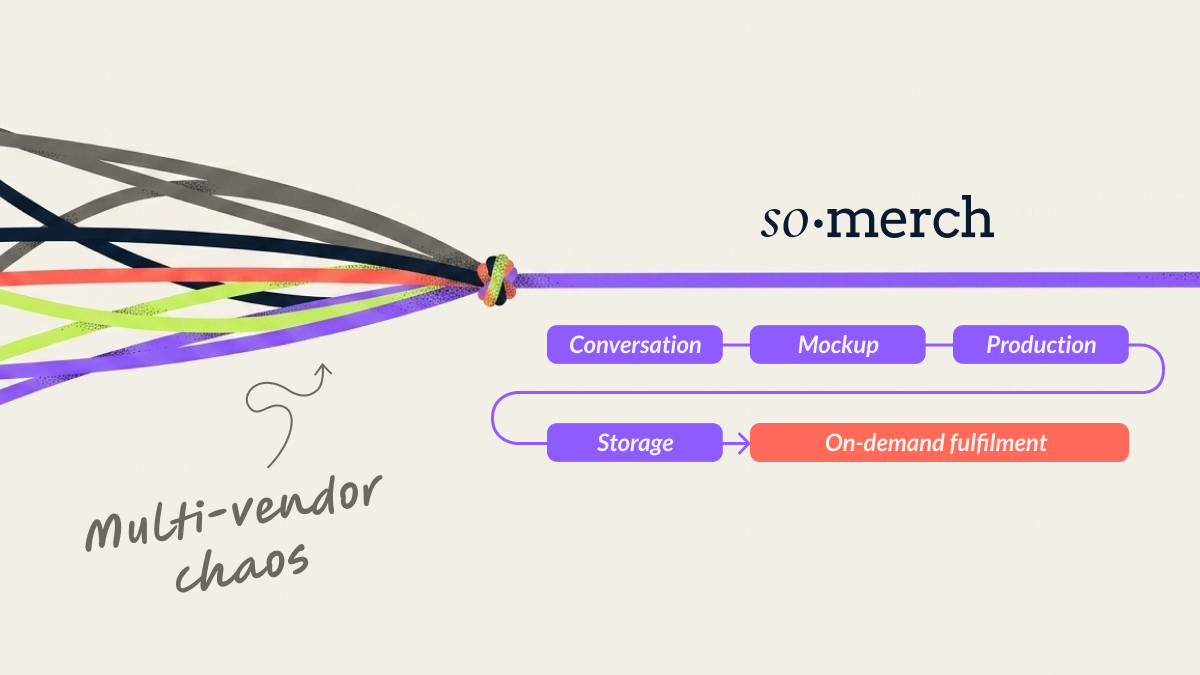
Intro
A brand identity project usually ends with a deck. Logo files, an exact color palette, typography rules, a page on tone of voice. Someone signs off on it, it gets circulated, and for a while it looks finished - a clean, complete answer to what the company looks and sounds like.
Then someone in the office needs fifty hoodies for the team offsite, a notebook for new hires starting in three different countries, and a set of mugs for a client gift box. And the guidelines deck, however well built, does not order anything, print anything, or ship anything. It just sits there as the reference nobody quite checks against once the actual ordering starts.
That is where brand identity gets tested - not in the design phase, but in the gap between the document and the object someone is holding.
The guidelines deck is the easy half
Brand identity work is genuinely good at producing a document. Exact hex and Pantone values. A logo with approved variations. Rules for spacing, for typography, for what not to do. On the day it is signed off, it is complete and correct.
What it was never built to survive is what happens next: the same spec being handed to five different people, in five different offices, each of whom needs to turn it into something physical, on their own timeline, through whatever vendor they already use.
A design system assumes one point of application. A distributed company rarely has one - and the more offices and vendors touch the identity between the deck and the delivered object, the more chances there are for it to drift without anyone deciding it should.
Where it breaks down in practice
Most merch vendors already carry a broad catalog - apparel, drinkware, stationery, all from one supplier and one point of contact. That part is not unusual, and it is not the problem. The problem is that a single vendor relationship rarely means a single production point. Most of those vendors subcontract the actual printing and decoration, which means the brand guidelines get applied by whoever that vendor happened to route the job to that week - not necessarily the same facility, or the same person, from one order to the next.
None of that shows up as an error at the time. Each order looks fine on its own. It only becomes visible later, when the hoodie shipped to the Berlin office and the hoodie shipped to the Warsaw office turn out to be two different weights of what was supposed to be the same navy - ordered through the same vendor, months apart, decorated by whoever was behind that vendor each time.
The guidelines were not wrong. Nobody was checking whether orders placed months apart, even through the same vendor relationship, still matched each other - because nobody in that chain actually controlled the print floor.
Why this is a coordination problem, not a design problem
It is tempting to read identity drift as a design failure - a color that was not specified precisely enough, a logo file that got compressed at some point along the way, a designer who should have written the guidelines more tightly. Usually none of that is it.
The identity fails because there is no single point where the spec gets applied consistently. A broad catalog with subcontracted production is still a fresh interpretation on every order, whether or not the vendor's name changes. Every office that orders on its own is a fresh chance for a slightly different print method or a slightly different stock. None of these gaps show up in the guidelines document, because the guidelines document was never the thing doing the printing.
More rules do not close that gap. A tighter usage guide does not help if nobody applying it actually controls the print floor.
What keeps it consistent
The fix is not a longer guidelines document or a stricter sign-off process. It is fewer places where the spec has to be reinterpreted.
When one production team, working from one set of color references and one set of files, is the one applying the identity to every order - apparel, drinkware, stationery, whatever the request - there is no translation layer between the guidelines and the object. And when a quality check happens before an order ships, not after someone in another office notices a mismatch, drift gets caught before it reaches a new hire's desk instead of after.
That is a coordination fix, not a design fix. The identity does not need to be redefined. It needs fewer hands touching the interpretation.
Closing the Gap in Practice
In practice, that means one production point handling every category - apparel, drinkware, stationery - from the same color references and the same logo files, with a quality check before anything ships rather than after someone notices a mismatch. Not a broader catalog. The same hands on every order. For a distributed company, it also means production and shipping working together: a single run, printed once to spec, reaching offices and new hires in different countries without each location placing its own separate order and inheriting whatever facility that order happens to land with.
SoMerch runs on this model - in-house production across categories, photo-proof QA before dispatch, and multi-address shipping across Europe, with stock held and shipped on demand rather than reordered from scratch every time someone in a different office needs the same item.
Closing
A brand identity is only as consistent as the last order placed against it. The guidelines can be exactly right and the result can still drift, order by order, batch by batch, office by office - not because anyone got the design wrong, but because nobody was the single point applying it.
The fix is not writing a longer document. It's closing the gap between the spec and the object - so the hoodie in Berlin and the hoodie in Warsaw are, in fact, the same navy.