Valentine's Day 2026: corporate merch and gift ideas
A customer-facing occasion, not an internal one. What to send, what to keep off the plan, and why the order window closes in early December.
Deadline = event date minus 14 business days (8 production + 6 shipping, on average). Recalculated daily.
Quick answer
Valentine's Day is a customer-facing occasion for European companies, not an internal one. Run it toward your customers as a small seasonal piece or a gift with purchase, write it for friendship and self-gifting rather than romance, and keep employer to employee gifting off the plan entirely. In 2026 the date falls on a Saturday, which pulls the commercial peak into the working week of 9 to 13 February.
What Valentine's Day is
14 February is the largest consumer gifting occasion of the first quarter and one of the biggest of the year across the whole European footprint. It is marked in all nine markets we ship into, but not evenly. France, Belgium and Spain treat it as a genuine social occasion with an established gifting habit. Germany, the Netherlands and Poland treat it as a commercial date: visible in retail, lighter in practice. Austria, Switzerland and Bulgaria sit between the two.
That gradient matters if you are running one European campaign. The same creative that reads as normal in Paris reads as heavy in Warsaw. Adjust the intensity by market rather than assuming the French version everywhere.
In 2026 the date is a Saturday. Consumer buying moves forward into the preceding week, so anything you produce has to be in hand and in the parcel by Friday 13 February at the latest.
Is it worth doing something?
For a company selling to consumers, yes. February is a thin month for retail attention and this is the one date in it that people are already looking for. For a company selling only to other businesses, it is optional and usually skippable. There is no B2B gifting convention attached to 14 February, and a Valentine's package landing on a procurement desk lands strangely.
Internally, the answer is a firm no. Employer to employee gifting framed around romance is an HR exposure rather than a creative choice. It singles out relationship status in a work context, it puts managers in the position of handing colleagues a romantic object, and it has no defensible upside that a different February gesture could not deliver more safely. In 2026 it also falls on a weekend, so there is no office moment to attach it to. If you want an internal date in this stretch of the calendar, Employee Appreciation Day on 6 March is the one built for it.
The part most February campaigns miss is that the growth in this occasion is not with couples. Buying for friends and buying for yourself are both large and under-served segments, and neither one carries the exclusion problem that the romantic framing creates. A campaign written for those two audiences reaches the couples anyway. The reverse is not true.
Merch ideas that hold up
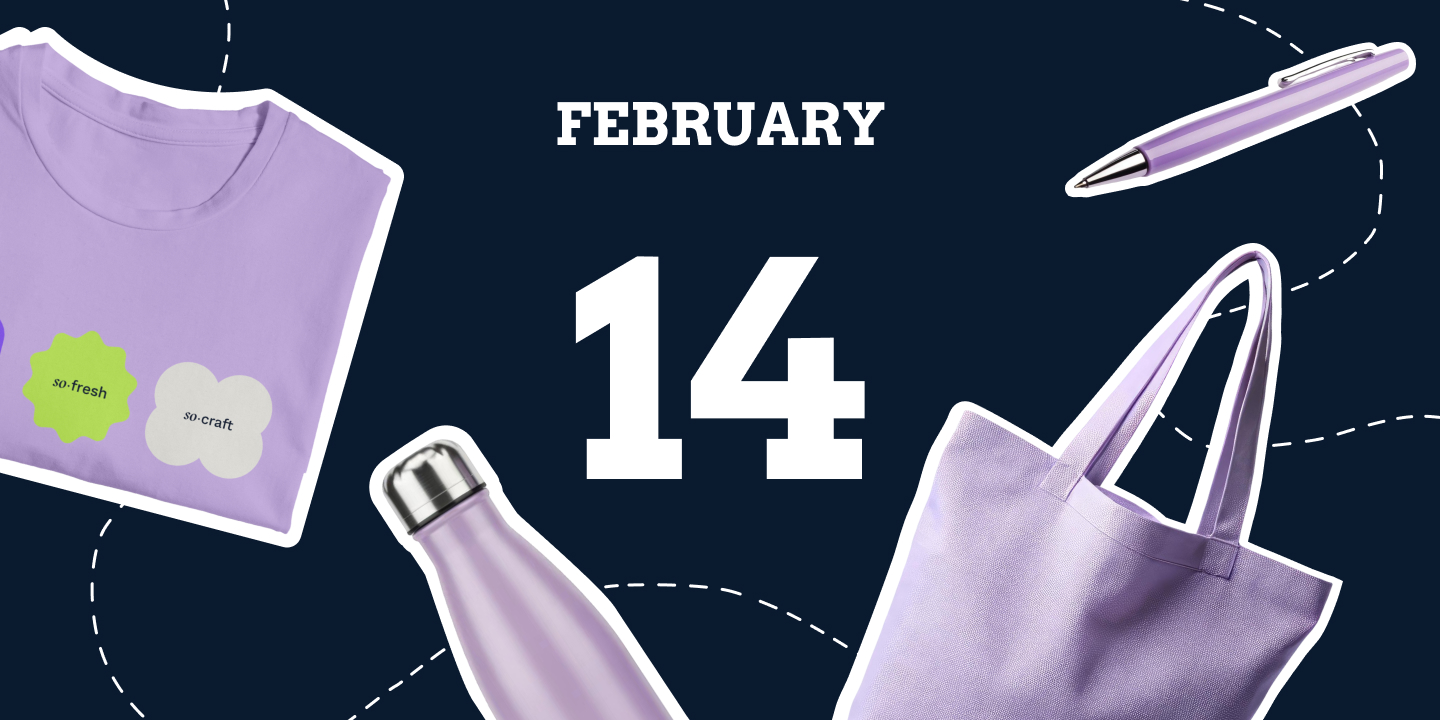
A seasonless object in a February sleeve. A good stoneware mug, a heavyweight cotton tote or a pair of properly made socks, printed in one colour with your own artwork and no date, then packed in a printed February sleeve or band. The occasion lives on the packaging, which gets recycled, and the object survives into March without looking like leftover stock. This is the single highest-return structure for any dated campaign and it works in every market on the list.
A gift with purchase sized to your existing parcel. A flat, light piece that slips into the box you already ship without changing the weight band or the packing process: a printed enamel pin, a card-stock coaster set, a slim notebook. The constraint that matters is dimensional, not creative. Bring us your current carton size and we will work inside it, which keeps the shipping cost identical to a normal week.
A card and sleeve system with the product left unmarked. Print the sentiment on a card, leave the item plain, and let the customer write and give it onward. This turns a single purchase into two impressions and it removes the awkwardness of a company deciding what somebody's relationship should say. Uncoated stock, letterpress or a single foil hit, and enough blank space to actually write in.
A named-maker consumable in an adult colourway. Shelf-stable sweets, coffee or tea from a maker we can name, in a printed giftable sleeve, with allergen information documented on the pack rather than assumed. Skip the red and pink default. A muted palette photographs better in an unboxing and does not look like every other February parcel on the shelf.
What to avoid
- Internal employer to employee gifting with a romantic frame. No exceptions, in any market.
- Alcohol on a mixed recipient list. Across nine markets you will hit observances, policies and personal circumstances you cannot see from a spreadsheet.
- Running the campaign without a marketing opt-out. Offering one is now standard practice and it should be the default, not a concession.
- Consumables without documented allergen information. This is a hard line on any parcel we produce.
- Printing the date or the year on the object itself. A February-dated item is dead stock on 15 February.
- Assuming red and pink. It is the crowded default, and a restrained palette is the differentiator rather than the compromise.
When to order
Start the conversation in early December for a mid-February arrival, and treat that as the real deadline rather than a comfortable one.
Working backwards: standard production runs about eight business days once artwork is approved, EU shipping takes two to six business days depending on destination, and personalisation or kitting adds handling time on top of both. That alone is around three weeks. Then two seasonal constraints stack on it. German and Austrian suppliers effectively close for the last week of December, which removes a full week from the middle of the window. And if any component is imported, the upstream factories close for two to three weeks around Lunar New Year, which in 2026 begins on 17 February. That closure sits just after Valentine's Day, so it does not threaten the first run, but it does mean there is no second run. If February sells through, the restock is not available until spring.
In practice: artwork and product decisions by the end of November, order placed in the first week of December, production before the Christmas shutdown, stock in the warehouse in January, parcels going out in the week of 9 February.
How SoMerch handles it
We source the base products, print them in house, assemble the packs and hold the stock in our own warehouse until you want it moving. For a February campaign that usually means producing in December, storing through January and shipping on your signal, either bulk to one location or direct to individual customer addresses across the EU. Allergen documentation, landed cost per market and VAT handling are part of the quote rather than a later surprise. If you want the February piece built around the parcel you already ship, send us your current carton dimensions and recipient split and we will quote it landed.