Start of summer 2026: corporate merch and gift ideas
The lowest-risk, highest-return date on the calendar. Build a set for a whole season, not one weekend, and order it in February.
Deadline = event date minus 14 business days (8 production + 6 shipping, on average). Recalculated daily.
Quick answer
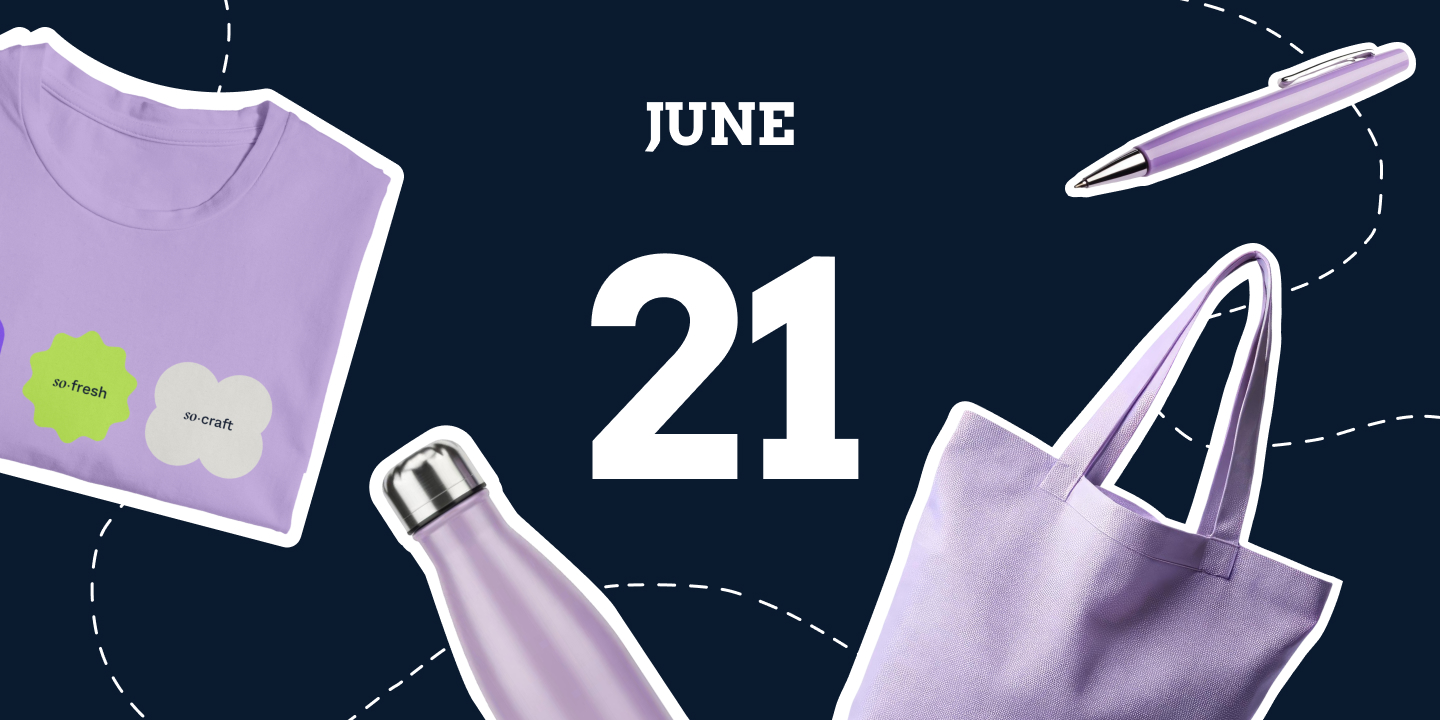
The June solstice is the best value date on the whole calendar because nobody is being honoured, so nothing can be got wrong about the relationship. Build one summer set that works from late May to September rather than for a single weekend: a picnic blanket or ground mat, an insulated bottle or cooler bag, and a garment-dyed tee or cap in a faded colourway. Order in February, land it in late May, and pull any southern hemisphere addresses out of the list before it ships.
What the start of summer is
The June solstice is the longest day of the year in the northern hemisphere and the astronomical start of summer. In 2026 it falls on Sunday 21 June. There is no obligation attached to it, no honoured recipient, no religious or national framing, and no group who can reasonably be left out. It is a mood rather than a ritual.
That makes it weak as a gift occasion and unusually strong as a seasonal launch. The whole footprint is northern hemisphere, so the season lands at the same time in Germany, the Netherlands, France, Spain, Poland and everywhere between. Commercially, summer opens well before the solstice: people are outdoors from late May, and a set that arrives on 21 June has already missed a month of use.
The one geographic trap is straightforward. If your address list includes anyone in Australia, New Zealand, South Africa or Latin America, June is their winter. A summer set arriving there is a visible mistake and an easy one to make from a global spreadsheet.
Is it worth doing something?
Yes, and this is one of the few dates where that answer needs no conditions attached. Three things make it work commercially.
It carries no sensitivity load, so there is no exclusion problem, no opt-out to build, and no version of the message that lands badly with part of the list. It has the widest possible use case: the same set works as an employee send, a customer gift and event kit for the summer conference and festival season, which is rare. And the items themselves have a genuinely long life. A cooler bag bought in June is still in use in September and again next May, which is not true of most seasonal merch.
The failure mode is not sensitivity, it is design. Most summer merch is built for a beach that most recipients are not going to. Build for a balcony, a park and a garden instead, and the keep-rate changes completely.
Merch ideas that hold up
The turn-any-grass-into-a-set-up mat. A picnic blanket or ground mat with a waterproof printed backing and a sun-faded pattern on the face, packing down into its own carry strap. One object with one clear job, and the job comes up every warm weekend from May onwards. Sublimation print gives you edge to edge coverage on the face, which is where a full artwork actually earns its place rather than a logo sitting alone on a corner.
The Friday-evening-outside kit. An insulated steel bottle or a cooler bag that genuinely holds cold for eight hours, plus a set of stackable unbreakable tumblers. Laser mark on the steel, wrap print in bleached tones on the bag. This is the part of the set that gets used on a Tuesday in July and again at a customer event in August, which is what separates a seasonal item from a seasonal gesture.
A garment-dyed tee or cap in a faded colourway. Garment dye is the whole point: the piece looks worn from the first day and stays that way through washing, instead of looking new for two weeks and tired for the rest of the summer. Single-position soft-hand print, not a hard block of plastisol that cracks. This is the item people wear at the weekend rather than only at the company event.
A full picnic scaled to one bag. Everything two people need outdoors in a single carry: plates, cutlery, a board, a cloth, a corkscrew or bottle opener, in a bag that is light enough to actually leave the house. This is the top of the range and the one that works as a customer gift or a long-service send, because the perceived value is visible before it is opened.
What to avoid
- Sun and palm iconography, and tropical saturation generally. The item should look like it has already had a good summer, not like a resort logo.
- Items that only work at a beach. Flip-flops and beach balls are the clearest example: most of your list is going to a garden, not a coast.
- Sunscreen, after-sun and any skincare without full cosmetic regulatory compliance for each destination market, including EU CPNP notification. This is the one hard legal line on this occasion, and it is the reason sunscreen with your logo on it is a longer project than it looks.
- Single-use party items and inflatables. They fail the day-after test and they are the first thing thrown away.
- Hemisphere error on a global address list.
- Date stacking. 21 June 2026 is also Father's Day in the Netherlands and France and the International Day of Yoga. Do not run three activations on one Sunday. Open the summer set in late May and let the solstice pass quietly.
When to order
February. This is the date where the ordering deadline does the most work, because summer stock in EU promotional supply is committed early and does not come back. Coolers, picnic blankets and insulated drinkware are among the predictable Q2 stockouts. By April the colourway you wanted is gone and you are choosing from what is left.
The arithmetic: standard production runs around eight business days, decoration adds a seven to fifteen day window, and EU shipping takes two to six business days depending on destination. Anything with an imported component has to clear the Chinese New Year factory closure in late January and February, which quietly removes weeks of capacity. Kitting a multi-item set adds assembly time on top, and a multi-address send to home addresses needs the size and address collection done before, not during, production.
Working back from a late-May launch, February is the month the conversation has to start. Order in February, produce in March, hold the finished stock in the warehouse, and ship it out in the week you choose rather than the week production finishes. That last part is what makes a set land on a Thursday in late May instead of trickling out over three weeks.
If it is already April, narrow the ambition: one strong item from stock that is still available beats a four-piece set assembled from whatever is left.
How SoMerch handles it
We source the base products, print and produce in house, assemble the kits and hold them in our warehouse until you want them to move, then ship across the EU to offices, event venues and individual home addresses for remote employees. Sizes and addresses are collected through the platform rather than through a spreadsheet you maintain, and the quote comes back as one document with unit prices, decoration method and timelines in it, so you can put it in front of whoever signs off without rebuilding it first. Southern hemisphere addresses get pulled and handled separately before anything ships.
Send us a headcount and a market list and we will come back with a summer set costed, timed and ready to land in late May.