Corporate Gifts in France
Christmas and year-end thanks are the clearest corporate gifting window in France. Quality, presentation, and a real connection to the recipient matter more than filling a large box, while employee moments, trade fairs, and regional events create focused uses throughout the year.
The short answer
Christmas and the end of the business year are the clearest shared moments for corporate gifts in France. The French Ministry of Economy explicitly discusses gifts to clients and business contacts at the end-of-year holidays, while the Lyon chamber of commerce treats business gifts as an established way to reinforce professional relationships.
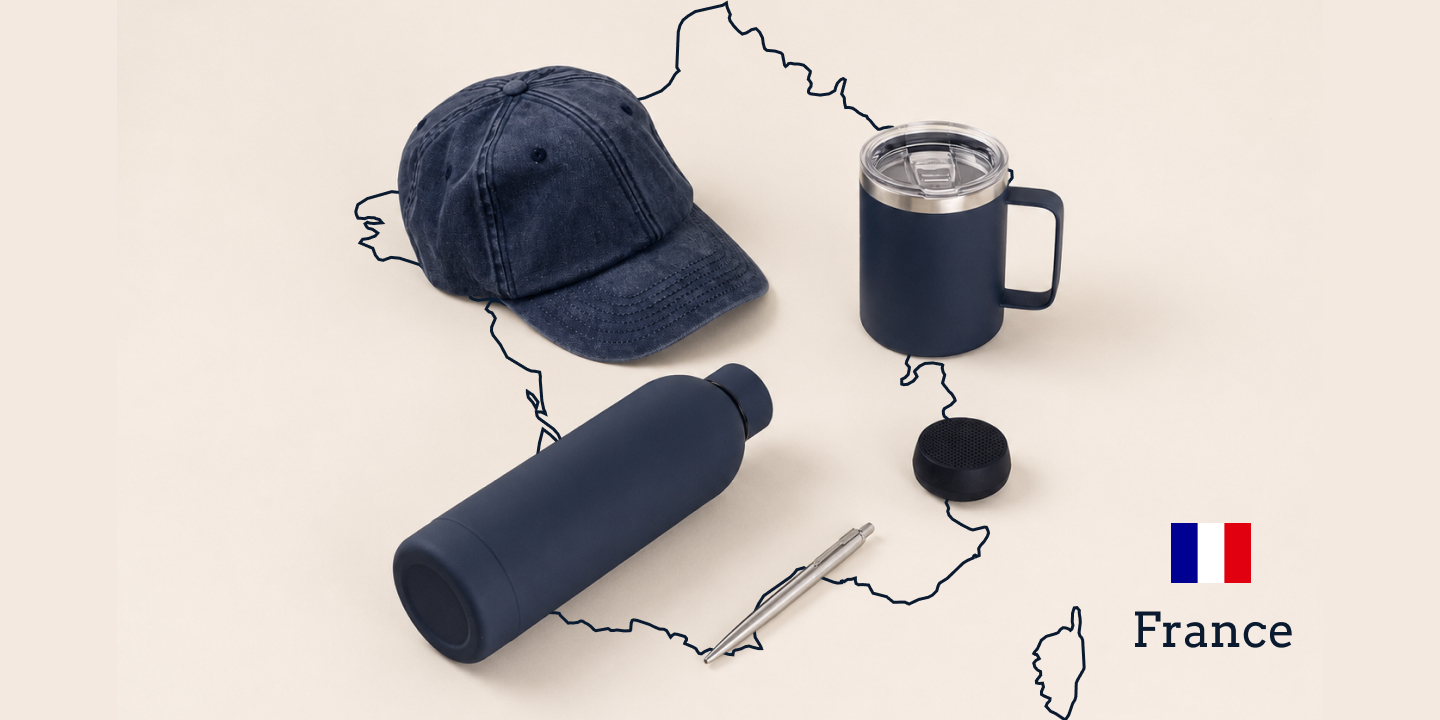
The safest gift direction combines three things: a useful object, a finish that feels considered, and presentation appropriate to the recipient. A large box does not automatically feel generous, and a product does not become a gift simply because it carries a logo. The object, card, and packaging need to read as one deliberate gesture.
Beyond December, France has several practical uses for company merchandise: employee arrivals and milestones, trade fairs, conferences, company events, project completions, and regional campaigns. These should not be forced into one generic gift program. Christmas is an annual batch. Recurring employee moments use held stock. Events and project milestones are produced for a defined audience and date.
France's corporate gifting calendar
| Moment | Who it is for | What fits | Planning approach |
|---|---|---|---|
| Christmas and year-end thanks | Employees, clients, business contacts | One quality hero item, a focused set, textiles, drinkware, desk items, or carefully selected regional food | Decide the direction before the autumn rush, produce as one annual batch, then split by office or address |
| Galette des rois - January | Internal teams | A shared food moment, perhaps supported by a simple reusable office item | Treat it as a team gathering, not a second large gifting campaign |
| Employee arrivals and milestones | New hires, work anniversaries, promotions, retirements | Apparel, drinkware, notebooks, bags, or a compact set matched to the moment | Produce a known quantity, hold it, and release units when each moment occurs |
| Trade fairs and conferences | Visitors, speakers, clients, internal event teams | Useful event items, staff apparel, compact takeaways, or speaker sets | Build around the venue, audience, transport, and the job each item needs to do |
| Company and project milestones | Teams and selected business contacts | A commemorative item tied to the date, project, or achievement | Produce for the known group rather than keeping a permanent generic gift |
| Regional and cultural campaigns | Teams, clients, or event audiences with a real connection | Locally relevant design, event merchandise, or regional production | Use a specific connection; do not reduce France to Paris, wine, or the tricolour |
Christmas is the anchor. France.fr describes Christmas markets and local savoir-faire as part of the season across the country, which gives companies a useful cue: a regional element can work when it has a genuine link to the recipients, but it should not be added as decoration without context.
January has a different rhythm. The galette des rois is well established as a shared workplace moment, but the gathering itself is the point. It may support a small office item or a team card, yet it does not need a complete merchandise set. Treating every cultural tradition as a product opportunity would make the Atlas less useful, not more.
Trade fairs and professional events form a serious year-round lane. UNIMEV's 2025 observatory reported positive momentum in France across exhibitors, visits, and exhibition space. For SoMerch, the relevant question is operational: what does the team, visitor, or speaker need during the event, and what will remain useful afterwards?
National dates such as 14 July are not automatic corporate gifting occasions. They can support a specific public event, hospitality program, international campaign, or French office activation, but only when the company has a real reason to use the date. The same rule applies to the Tour de France, Cannes, fashion weeks, and regional festivals.
What companies actually give
A strong gift for a French employee or client does not need to imitate a luxury hamper. It needs a clear point of view and enough restraint to let the recipient use it.
For employees:
- Wearable apparel - hoodies, sweatshirts, t-shirts, overshirts, or caps with proper size collection and a design that works away from the office.
- Drinkware - insulated bottles, travel cups, and mugs that fit office, home, and commuting routines.
- Desk and workday items - notebooks, pens, laptop accessories, and compact organizers with visible quality in daily use.
- A focused set - one main object with one or two supporting pieces, rather than a box padded with minor items.
- Regional food additions - useful for year-end or a local event when dietary needs, alcohol, fragility, and delivery conditions have been checked.
The item should reflect the moment. A first-day set helps someone start. A work-anniversary gift recognises contribution over time. A retirement gift should feel personal enough for the occasion and should not resemble spare trade-fair stock.
For clients and business contacts:
Presentation matters, but restraint matters too. A well-finished notebook, quality drinkware, compact textile item, or carefully chosen regional product can work better than a large mixed hamper. Keep the company identity discreet enough that the object still feels like a gift. A card written for the recipient often carries more weight than another layer of packaging.
For events and trade fairs:
Choose for the event job. Staff apparel should make the team easy to find and remain comfortable. Visitor items should be light, packable, and useful after the event. Speaker sets can be more considered, but every item still needs a reason to be there. A generic bag filled with the usual small objects is not automatically useful simply because the event has a large audience.
Local etiquette and design choices
Quality should be visible, not announced
Material, finish, and print quality should carry the value. A gift that needs several paragraphs of premium language to explain why it is good is usually working too hard. Choose fewer pieces and execute them properly.
Use the logo according to the relationship
Internal apparel can carry a stronger company identity when the design remains wearable. Event staff need clear identification. Client gifts normally benefit from a smaller mark, a quiet placement, or identity carried on the card and packaging rather than across the whole product.
The test remains simple: would the recipient still choose to use the item if the logo were smaller? If the answer is no, revisit the product or the design.
Write for the recipient's language
For a French employee or client audience, French cards, packaging copy, and instructions usually feel more deliberate than default English. International teams may use English or bilingual materials, but the choice should follow the actual working language of the recipient group.
Food and alcohol need a reason
France has strong regional food and drink traditions, which makes them tempting shortcuts. They can work very well, but they are not universally suitable. Check dietary needs, alcohol preferences, storage, breakage, and private-address delivery before building a program around them. A regional product should connect to the sender, recipient, or event rather than serve as a generic symbol of France.
France is not one visual theme
Paris, Brittany, Provence, Alsace, Lyon, Bordeaux, Lille, and the overseas territories do not share one design shorthand. Use regional references only when the audience has a real connection. Otherwise, the company's own identity is more credible than borrowed imagery.
Packaging should be composed, not excessive
Packaging needs to protect the contents, organize the set, and make the gesture easy to understand. It does not need multiple boxes, ribbons, and filler layers. Compact packaging also performs better when a batch is divided across offices and private addresses.
Planning and ordering for France
The moment decides the operating model.
Christmas and year-end gifts follow an annual production cycle. Define the recipient groups, gift direction, design, quantity, language, and delivery model once. Produce the batch, separate office deliveries from private-address deliveries, and keep only a sensible surplus for late list changes. The next annual production run is the natural point to review whether the gift still fits.
Recurring employee moments use held stock. Produce a known annual quantity for onboarding or work anniversaries, store it, and release one unit whenever the date occurs. Manager-triggered moments such as promotions use a standing choice that is replenished when stock runs low.
Events and project milestones use triggered batches. The audience and date are known, so the product and quantity can be designed around that specific job. Avoid turning every event item into permanent stock unless the same format genuinely repeats.
Before production starts, settle the information that usually creates delays:
- Recipient groups and quantities
- Apparel sizes where textiles are included
- Office and private delivery addresses
- Correct receiving entity for each office or country
- French, English, or bilingual card and packaging versions
- Internal design and budget approval
- One owner with final sign-off
France sits inside SoMerch's normal EU operating model. A single program can cover a French office and teams in other EU countries, with separate invoices for the relevant receiving entities and stock divided between offices or individual addresses. Production, printing, assembly, and quality control stay together before the order is split for delivery.
How to run a France gifting program
- Define the moment. Christmas, onboarding, a work anniversary, a trade fair, and a project completion require different products and quantities.
- Separate recipient groups. Employees, clients, visitors, and speakers should not receive the same item by default.
- Choose one clear direction. Start with the hero item and add supporting pieces only when they improve the set.
- Confirm the operational data. Quantities, sizes, addresses, entities, languages, and approvals should be settled before production.
- Produce and check the batch. Printing, assembly, and quality control happen before stock is divided by destination.
- Store or distribute according to the moment. Annual gifts ship for the planned window; recurring employee gifts remain in stock and are released when triggered.
- Review before repeating. Keep what people use, remove what they ignore, and refresh the design at the next production run.
Frequently asked questions
When do French companies usually give corporate gifts?
Christmas and the end of the business year are the clearest shared window. Employee arrivals, work anniversaries, promotions, retirements, trade fairs, company events, and project completions create more focused year-round moments.
Is the galette des rois a corporate gifting occasion?
It is better understood as a shared workplace ritual than a major gifting campaign. A small supporting item can fit, but the galette and the team gathering are the main event.
What corporate gifts work well in France?
Useful, well-finished items are the safest starting point: wearable apparel, drinkware, notebooks, desk items, compact bags, and focused sets. Regional food can work when it has a genuine connection and the delivery conditions have been checked.
Should the company logo be visible?
Yes, when visibility serves the purpose. Staff apparel at an event needs clear identification. Employee apparel can carry a stronger design if it remains wearable. Client gifts normally benefit from a smaller mark or identity placed on the card and packaging.
Is 14 July a good company gifting moment?
Not by default. It can fit a specific event, hospitality program, French office activation, or international campaign. Without that connection, it is simply a national date, not a reason to produce gifts.
Can one program cover employees in France and other EU countries?
Yes. Gift direction and production can be shared, while language, recipient data, quantities, addresses, and invoices are handled by receiving entity and destination. This is cleaner than rebuilding the same program country by country.
For moment-specific guidance, see Gift Ideas. For materials, printing, and file preparation, use the Merch Field Guide. The Merch Calendar helps identify planning windows without treating every public holiday as a merchandise occasion.
Sources
- French Ministry of Economy - Christmas gifts for clients and business contacts - End-of-year gifts to clients and business contacts in France.
- CCI Lyon Métropole - Cadeaux d’affaires and professional relationships - Business gifts as an established relationship practice.
- France.fr - Major events and Christmas markets in France - Christmas markets and regional savoir-faire.
- UNIMEV - 2025 French events observatory - French trade-fair and events activity.
- CRIOR - Galette des rois in the workplace - Galette des rois as a shared workplace moment.