The Most Common Merch Mistakes That Create Extra Work for Office Managers
The same handful of merch mistakes create most of the extra work office managers end up doing. Here's what they are and how to avoid them.
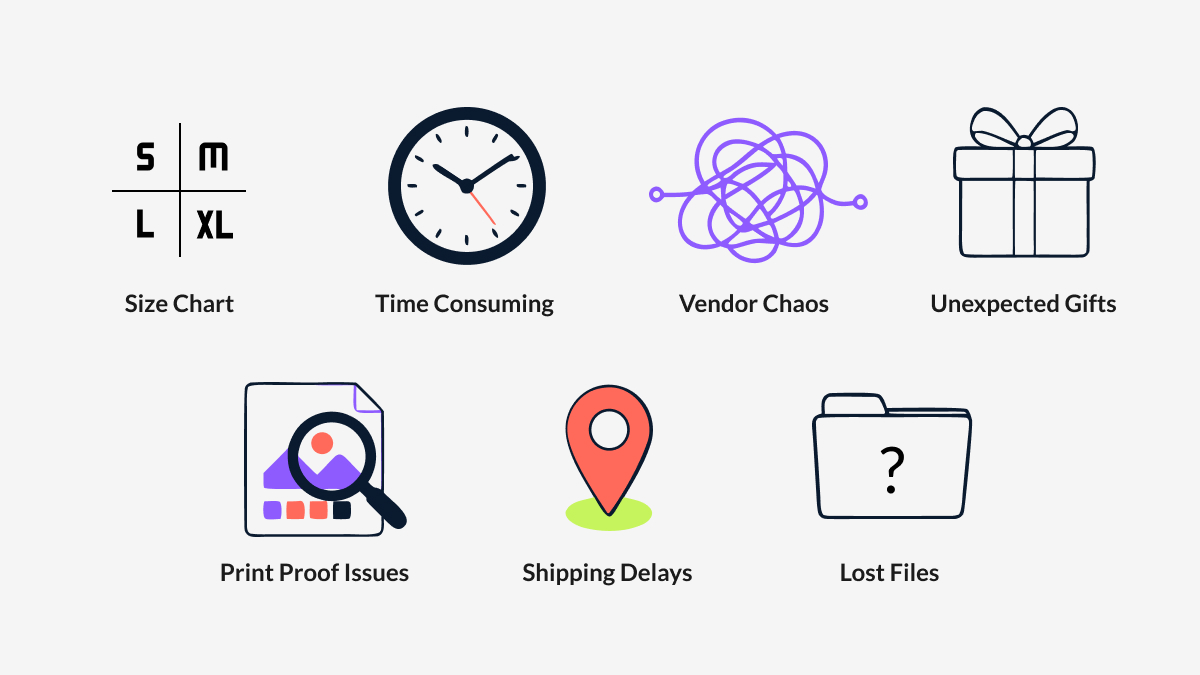
Intro
Most merch projects that turn into a headache did not go wrong because of the product. The mug was fine. The hoodie was fine. What went wrong was almost always one of a small, repeating set of process mistakes - the same ones, across different companies, and often the same one twice from the same office manager, because nobody wrote it down the first time.
Here are the ones that show up most often, and what they actually cost.
Mistake 1: Ordering without a size breakdown
Apparel gets ordered by headcount instead of by an actual size distribution. Fifty people need hoodies, so fifty hoodies get ordered - evenly split across sizes, or worse, guessed at based on what a typical office usually needs.
The problem shows up two weeks later, when the run of size L is gone and three people are still waiting, or when a run of size XS sits unused in a box because nobody on the actual team wears it. A size breakdown takes one email and five minutes to collect - a shared form, a quick reply-all, whatever is easiest to gather from the actual recipients. Skipping it turns into a second, smaller, more annoying order placed under time pressure, usually at a worse price point because it is now urgent instead of planned.
Mistake 2: No lead-time buffer
The order goes in for exactly the date it is needed, with no room for anything to shift. Production timelines are estimates, not guarantees - a supplier can run a day or two behind, a proof can need one more round of changes, an address can turn out to be wrong and need correcting.
None of that is unusual. What is avoidable is planning as though none of it will happen. A buffer of even a few days absorbs the kind of small delay that is completely normal in production, instead of turning it into a missed deadline that someone has to explain.
Mistake 3: Mistaking a broad catalog for in-house production
Most merch vendors already carry a wide catalog - apparel, mugs, bottles, tech accessories, all under one storefront and one point of contact. That part is not the problem, and it is not even unusual. The mistake is assuming that a broad catalog and a single relationship means that vendor is the one actually making the item.
Often, they are not. The catalog is broad because the vendor is reselling and coordinating, not producing - the actual printing and decoration is subcontracted to a factory or decorator the buyer never sees and has no relationship with. That works fine most of the time, right up until a batch comes back slightly off: a color that does not quite match the last run, a logo placed a few millimeters differently than the mockup. At that point, the vendor has to go back to their own supplier to find out what happened, with barely more visibility into the answer than the buyer has.
One point of contact feels like one point of accountability. It is not the same thing, and the gap between them only becomes visible once something needs fixing quickly and nobody in the chain actually controls the print floor.
Mistake 4: Ad hoc gift processes
Work anniversaries, birthdays, and the December gifting round get handled as a fresh decision every time they come up, instead of as a standing plan. Someone remembers a week before, orders whatever is fastest to source, and the process resets before it ever became a process.
The cost here is not just the scramble. It is the inconsistency - one employee gets a thoughtful gift, another gets whatever was available on short notice, and there is no way to tell in advance which one any given person will get.
Mistake 5: Skipping the proof step
A mockup gets approved on screen, and the order goes straight to full production. Most of the time this is fine. The times it is not fine are expensive: a color that reads differently in print than on a monitor, a logo placement that looks slightly off on the actual product, a stitching detail that was never visible in the digital version.
A physical or photo proof before full production catches this before it is two hundred units deep. It adds a day, sometimes two. It is a cheap trade against reprinting an entire run.
Mistake 6: Not accounting for distributed shipping
The order gets planned as though everyone receiving it is in the same building. Then the list turns out to include a remote hire in another country, or a client office two borders over, and shipping becomes an afterthought bolted on at the end instead of part of the plan from the start.
This is where timelines slip the most, because cross-border shipping was never actually budgeted for - not in time, and not in the coordination it takes to get an address, a customs detail, or a courier arrangement right on the first attempt.
Mistake 7: No saved reference for reorders
The mockup, the final size list, the exact color spec - all of it lives in an email thread or a chat message from six months ago, not in a file anyone can find again. Reordering the same welcome kit or the same event giveaway means digging through old messages, or worse, rebuilding the spec from memory and hoping it matches what shipped last time.
This is a small mistake with a compounding cost. The first order absorbs the cost of getting everything right. Every reorder after that should be faster, not the same amount of work all over again - and it only gets faster if the information from the first order was actually saved somewhere both sides can find it.
Closing
None of these mistakes are about choosing the wrong product. Every one of them is about the process around it - the size list that never got collected, the buffer that never got built in, the production nobody was actually watching, the gift process that never became a process, the proof step that got skipped, the shipping that got planned last, the spec that never got saved anywhere. Which is also exactly why they are avoidable: fix the process once, and the same mistake does not get to repeat itself on the next order.