


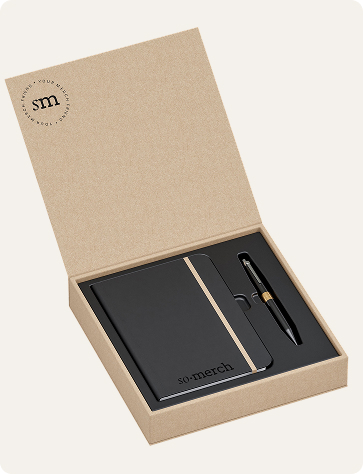


Small Corporate Gifts: A Modest Budget Isn't a Lower Bar

A small corporate gift and a cheap one aren't the same thing. One is a modest, considered gesture. The other is a promotional freebie that happens to have the same price tag. At a tight per-unit budget, it's genuinely easy to aim for the first and end up producing the second without meaning to - and the recipient can tell the difference the moment the item is in their hand.
Small is a budget constraint, not a quality ceiling
A modest per-unit spend limits which items are realistic to choose from. It doesn't have to limit whether the item that gets chosen feels considered. Those are two separate questions, and it's easy to let the answer to the first one quietly answer the second too.
The actual failure isn't spending a small amount. It's the specific choices that tend to get made under a tight budget without anyone deciding them deliberately: a thinner material because it shaved a few cents off the unit cost, a generic off-the-shelf item because sourcing something better felt like too much effort for the spend involved, a print finish that's slightly inconsistent because quality checking felt like overkill for a small gift. The line between "small and thoughtful" and "a promotional freebie" is thinner than it looks, and a tight budget makes it easy to cross without anyone intending to.
Where it actually breaks down
At volume, per-unit price tends to become the only variable anyone actually tracks, and finish quality quietly gets deprioritized in service of protecting that number. There's a real difference between the cheapest item available at a given price point and the best item available at that same price point - and under time pressure, the first one often gets chosen simply because it's faster to justify in a spreadsheet.
Take a fairly ordinary case: a company hands out a small item to the entire office for a minor occasion - nothing elaborate, just a gesture. Per-unit cost was the only real criterion in the decision. The batch arrives, and the print quality is noticeably inconsistent from unit to unit - crisp on some, slightly smudged on others. The gesture, genuinely well-intentioned, reads as an afterthought instead, because nobody checked a sample before the full run went ahead.
Volume itself makes this worse than it would be for a larger order. A luxury gift for ten executives can absorb one slightly-off unit fairly quietly - it's one conversation, easily smoothed over. A small corporate gift distributed to two hundred people means any quality inconsistency in the batch gets seen by two hundred people, all at once, which is a much less forgiving audience for exactly the kind of small execution gaps that a tight budget makes more likely in the first place.
Why this is a perception-threshold problem, not a spending problem
Nobody picking small corporate gifts actually wants the result to read as cheap. The budget constraint behind the decision is almost always real - a genuine limit on what's available to spend, not a sign of low effort or low care from whoever's making the choice.
What usually gets overlooked is recognizing that at a modest budget, the factor that matters most shifts. It's no longer "which item looks most impressive" - that question mostly answers itself once the budget is fixed. It becomes "which item holds up consistently at this specific price point and this specific volume," which is a narrower, more practical question that tight-budget decisions often skip past on the way to picking whatever's cheapest. The threshold between something that reads as small-but-considered and something that reads as cheap-and-forgettable is set almost entirely by consistency and finish, not by the number printed on the invoice.
What keeps a small gift from reading as cheap
The fix starts with choosing a genuinely well-made item within the available budget over a flashier-looking one that only hits that price by cutting corners somewhere less visible on a spec sheet. A simpler item, made well, reads better every time than a more elaborate item made carelessly at the same cost.
Protecting print and finish quality as the one non-negotiable - even if it means simplifying the item itself to make room for it in the budget - keeps the gesture from crossing the line into promotional-freebie territory. And checking an actual production-quality sample before committing to a full volume run matters more here than almost anywhere else, precisely because small-budget items are exactly where corner-cutting is most tempting for a supplier and least visible until the whole batch has already arrived.
How SoMerch fits
Tiered quality checks with photo proofs before dispatch apply at every budget level, not just on premium orders - a small corporate gift's finish gets checked with the same rigor a luxury order's would, rather than getting waved through because the per-unit spend is modest. Because production happens in-house, volume doesn't automatically mean the order gets routed to whichever subcontractor can hit the lowest per-unit cost that particular week, with quality as whatever's left over after the price is negotiated.
Mockups produced the same day mean the actual finish and material can be confirmed before a company commits to two hundred units, not discovered for the first time once the full batch has already shipped. This connects to the broader corporate gifting problem covered elsewhere: a small gift is still a gift, and the same coordination and execution gap that breaks a large, expensive order breaks a modest one just as easily - the budget changes what's realistic to buy, not whether the result needs to actually hold up.
Closing
A small gift and a cheap one are different things, and the difference shows up entirely in the recipient's hand, not on the invoice that produced it. The fix isn't spending more than the budget allows. It's protecting quality and consistency within whatever budget is actually available, instead of quietly letting the number do all the deciding.
Get a quote and visuals within 24 hours

No commitment required. Just clear, practical guidance for your team.